What Is Divorce Therapy? A Guide to Managing Anxiety, Grief, and Major Life Change
The goal of every person going through a divorce is to end up happier, healthier, and more at peace than when they started it.
But with the enormous stress of changing everything - your daily routines, your identity, your parenting - it can feel impossible to manage your anxiety and grief while executing the logistical demands of creating a new life.
Oftentimes, the well intentioned advice just doesn’t cut it:
Look on the bright side.
Screw him! You’re better off.
At least you’ll be free now.
Or, my personal favorite - you’re strong, I know you can get through this.
Rock, meet hard place.
You already feel overwhelmed, and now you aren’t strong? You’re both wildly anxious AND judging yourself for being anxious. You’re sure you should be fine and yet… you aren’t.
So you work hard to fix everything. Change all of the daily logistics, wondering if it will ever get easier. Set up a dating profile to prove you’re ready. Say no to friends because you don’t want to worry or bore them with how you’re still struggling.
It can make you feel alone. Scared. Bewildered.
Take a deep breath.
Today, I’m going to share how therapy for divorce will help you feel steady on your feet, understand and help your feelings, and rebuild a life you love. No platitudes, no pressure.
I'll cover individual counseling for divorce, how it works and how you can get started.
Keep reading for more details.
What Is Therapy for Divorce Recovery?
No matter what led to the separation or divorce, ending a marriage feels like the Titanic sank. You’re gripping the door, watching your hopes and dreams freeze to death, desperate for help. Individual therapy for divorce recovery is a life raft that pulls you out of the water.
Many of the anxious women I work with in Greenville, SC first seek therapy for divorce when their anxiety begins to overwhelm their lives. Panic attacks in the grocery store, crying in their workplace bathroom, crippling parenting guilt. I meet them with compassion, clinical skill, and together we get her to a better place.
Therapy for divorce recovery has three main components: calming the nervous system, making meaning of the divorce, and rebuilding life after separation.
Calming the Nervous System
Therapy aims to stabilize and heal your nervous system from the wear and tear of daily stress. Calming panic, reducing overthinking death spirals, and regulating overwhelming emotions.
With a calmer nervous system, you can sleep, rest, and function again. Therapy for anxiety in this time equips you with useful skills during this major life change.
Making Meaning of the Divorce
Therapy gives you time and space to foster meaning from the pain and grief of change. Understanding patterns in the relationship that got you here. Processing the grief, anger, and disappointment so you can move forward.
It hands you the pen and allows you to write the story of what happens, what it means, and moves you from rumination to clarity.
Rebuilding Life After Separation
A therapist can help you both envision a new life and provide the tools to build it. Rebuilding daily routines that encourage self care and tactile support. Redefining personal priorities and values so you can create the life you think is important. Strengthening support systems so you don’t feel alone even though you’re single.
These three pieces together turn this part of your life from ‘moving on’ to recovering with resilience. Stronger because of the divorce. More confident than before.
Live in SC? Schedule your free consult call now.
Why Is Therapy for Separation and Divorce Important?
Studies show that people going through a divorce are likely to experience an increase in anxiety, depression, stress, and social isolation. Which makes sense - divorce is the second most stressful life change, after the death of a loved one.
Something I hear from the women experiencing divorce in Greenville, SC is divorce feels kind of like a death - the end of hopes and dreams, of autopilot routines, of relationship constants. But you still are interacting with the person who was part of the death.
That cognitive dissonance can be dizzying.

The anxiety women experience during separation and divorce is undeniable. Feelings of loneliness, inadequacy, shame, and self doubt are common. People also report panic attacks, difficulties sleeping and eating, and isolating themselves.
By engaging in therapy, the anxiety and depression that naturally comes from such a shocking life change can be understood, reduced, and eventually healed. This way you can find a life that is fulfilling, meaningful, and deeply connected again.
Also, therapy for divorce recovery gives you the ability to regulate the nervous system overwhelm and a structured processing to prevent long term rumination and shame. No pity party. No denying the pain either.
That means you won’t have to keep reliving this time of your life forever. By combining emotional processing and practical stabilization in a caring, judgment-free zone, you grow stronger and more confident.
How Divorce Therapy Supports Difference Phases of the Process
If therapy for divorce or separation still sounds overwhelming, I get it. There’s a lot to do in the beginning of this change.
Finding a new place to live, getting your financial house in order, figuring out what or how to tell people, and guiding your children through this time too.
Here are some examples to show you different ways therapy can help throughout separation and divorce. These are general themes I’ve seen in my work as a therapist for anxious women going through divorce.
No matter if you’re contemplating divorce, or the ink dried on that paperwork years ago, therapy can be a helpful place for you.
Example #1. Discerning Whether It’s Time to End the Marriage
Therapy provides a space to explore the relationship honestly: examine patterns, identify emotional needs, and differentiate between solvable problems and deeper incompatibility. This work can be individual counseling, or couples counseling.
Although starting therapy when the relationship is ending may seem like a cliche, it’s a classic strategy for a reason. If you are a perfectionist or overachiever, figuring out what decision is best for you and your family can be complicated. You might be filled with shame and harsh self judgment for just asking the question.
Therapy for discernment focuses on clarity and self trust. This isn’t about persuading you or your partner to stay or leave. It’s about finding the path forward, one step at a time.
Therapy at this stage reduces anxiety and the overthinking loops of doom around this decision. We get to leave judgment at the door, and look at all the pieces with clarity, together.
Plus, it helps you make decisions aligned with what really matters to you instead of fear, pressure, or expectations of ‘what’s right.’ I help you figure out what’s right for you.

That means no matter if you stay or if you go, your next steps forward will be made with confidence, flexibility, and understanding.
Example #2. Therapy After Separation
In South Carolina, you need to be legally separated for a year before the divorce can be finalized. A year is a long time. All that time can be a pressure cooker for panic, overwhelm, and self doubt to explode.
That’s where therapy after separation comes in.
Therapy at this stage focuses on stabilizing when the emotional shock hits. You’ve moved, filed the separation papers, and established a custody schedule. It felt like you were just ticking boxes on a normal to do list for a while.
But now all of the tasks are completed, it’s totally normal for the panic to start.
Emotional shock during separation can look like…
Panic and emotional flooding
Grief stages like bargaining, anger, and second guessing
Identity loss and change
Disrupted routines and sleep
Intense rumination and overthinking about the relationship
In therapy after the separation, I help clients stabilize their nervous systems and give them the tools that will help after sessions. This is where divorce recovery therapy work really begins.
We start regulating overwhelming emotions and anxiety. You gain skills beyond ‘take deep breaths’ or ‘pray about it’, and learn how to understand and work with your body effectively.
Therapy after separation also supports grief processing while recreating a new life. It’s okay to bargain, change your mind every two minutes, or be furious with your ex (or yourself). In therapy, you can bring all your feelings to be organized and supported.
You’ll also learn how to create new daily routines that support your nervous system, and your new values.
Related Post: The Perfect Ritual for a Nervous System that Can’t Turn Off
Example #3. Therapy for Co-Parenting After Divorce
As I mentioned earlier, divorce is extremely stressful. The second most stressful life change an adult can go through. But what if it isn’t just grown ups going through this change?
Studies show that parental divorce is the 4th most stressful life change a child can experience. When my clients start therapy for divorce recovery with me, their number one question is ‘How do I help my kids?’
It’s like you and your partner built a Jenga tower together. Layers of friendship romance, and partnership first. Then taller layers of home life, career building, and children.
Divorce takes big handfuls of blocks out of that tower, and you’re left holding your breath, hoping the whole tower doesn’t collapse on top of your kids.
Therapy for co-parenting helps clients navigate the unique challenges of doing the most important job (parenting) with a person you have very complicated feelings about (your ex).
Communication with a former partner
Emotional triggers during parenting interactions
Balancing personal boundaries with relational cooperation (both kid relationship and former partner/family relationships)
Creating daily routines that work for single parenting
Supporting children through the transition.
Therapy for divorce recovery includes crystalizing your parenting values so no matter what emotion or experience pops up, you have reliable north stars guiding your choices. This improves emotional regulation during difficult co-parenting interactions and clarifies decision making.
Therapy for co-parenting also gives you as the parent the experiences and tools to give your kids a safe haven during this stressful time. As a former play therapist, I bring my expertise in child development and attachment science to make sure you are the big, strong, wise, and kind parent your kids need.
How to Find a Qualified Therapist Specializing in Divorce
Here are a few tips to help you maximize your results with therapy for divorce:
First: Look for Therapists Who Understand Divorce as a Life Transition
To achieve the best outcome for therapy, you have to find someone who understands the totality of change a divorce means. You want someone who is experienced in the practical and emotional steps in separation and divorce recovery. You also want to look for a therapist who has a lot of skill supporting people with grief and anxiety.
When you work with a therapist, you want to feel seen, heard, and felt. Effectively you’re looking for a compassionate and safe environment that can allow a safe attachment with yourself.
If you’re seeking therapy for divorce in Greenville, SC there are amazing in person and online options depending on your needs.
Related Post: How to Know if I’m Ready for Online therapy for ADHD Perfectionism?
Next: Find a Good Fit
Research shows that the relationship between the therapist and you is the greatest predictor of positive outcomes. More than any tool or training the therapist has, you want to make sure your therapist is a good fit. You want to feel comfortable, confident they understand and support your goals, and understand how you’re feeling.
When you find a therapist who really gets you, you know that no matter whether they’re using CBT worksheets or EMDR techniques, you’ll be getting the positive outcomes you wanted when you signed up.
In other words - it’s all about the fit.
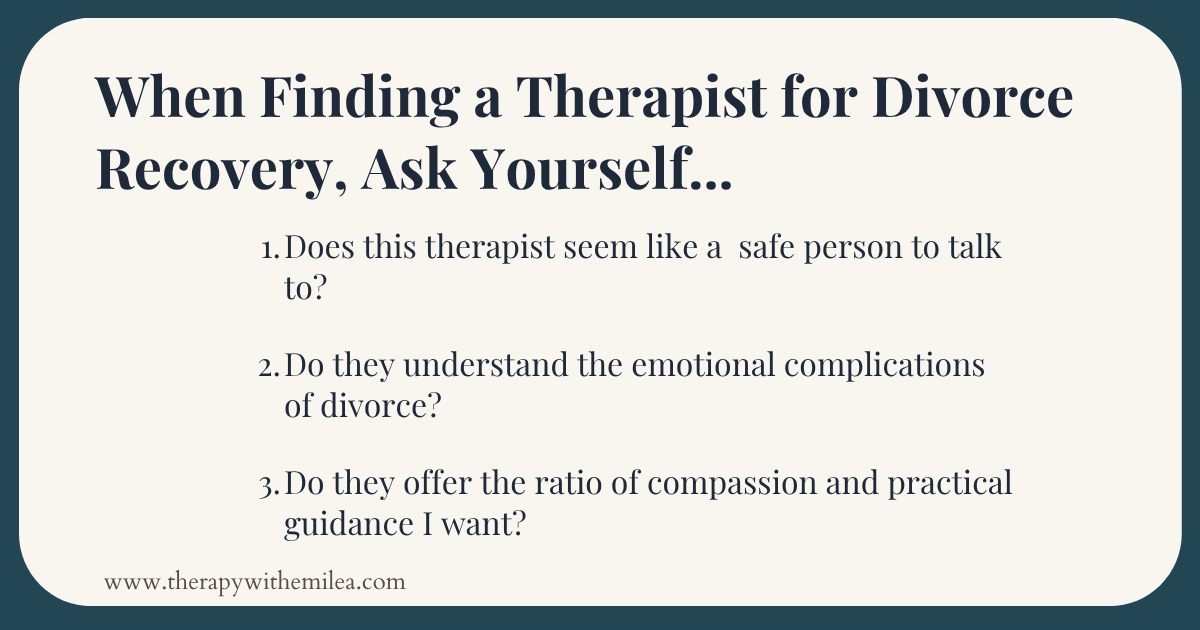
Consider the following questions as you read through Psychology Today profiles or someone’s website:
Does this person seem like a safe person to talk to?
Do they understand the emotional complications of divorce?
Do they offer the ratio of compassion and practical guidance I want?
Sometimes you can answer these questions just based off someone’s photo. Seriously, there’s research supporting that we can reliably predict if we’ll feel safe around someone just based off of a photo. You’re not being vain, you’re being discerning.
Other times the therapist’s website, profile, or blog posts can give you these answers.
But the best way to know for sure though is the consult call.
Finally: Interview Potential Therapists
Nowadays, people prefer to pick a professional that’s easy to access. A physician closest to your office, a dentist that takes your insurance, a personal trainer you can text.
Ease is important, don’t get me wrong. But the potential positive outcome you can get from therapy is huge. The ways a therapist can support you during this major life change is critically important. So I want more for you than just ‘they’re close to work and take my insurance.’
Think about finding a therapist like hiring someone to work for you. To make sure you’re getting the best person, you want to look at many options to be sure you’re getting the best. Not just the first person who emails you back.
When finding a therapist, we don’t usually use the word interview, we say “consultation call.” A consultation call is 15-20 minutes on the phone or even video chat where you get to share a little bit of your situation, and ask about the therapist’s experience and approach.
I always encourage friends and loved ones looking for a therapist to set up multiple consultation calls with potential therapists.
If you want to reduce anxiety during separation and divorce quickly, you can’t overlook this crucial step. No need to invest an entire hour of a first session if you know in the first 15 minutes this isn’t you’re person.
When you interview multiple therapists, you discover your options and make the choice that fits your needs best. Then you can hit the ground running in session one, and feel confident you’re going to accomplish your therapeutic goals.
And if the idea of asking for a consultation call makes you nervous, I get it.
Here’s the secret…
Most therapists offer a free consult call for a reason - it saves them time and investment as well.
We therapists want to help people, and we know that we cannot possibly help everyone. We want to be matched with our people quickly so we can do great work. The consultation call is a way to honor your time and theirs.
Again, most therapists already offer a call as a free and first step in starting therapy with them. Plus, most therapists already offer this for free as a natural first step in the process of starting therapy. That means if you don’t interview multiple therapists, you’re missing out on a crucial step to protect your time, income, and emotions.
Take a screenshot of this picture to give you some good go-to questions for your consult calls!
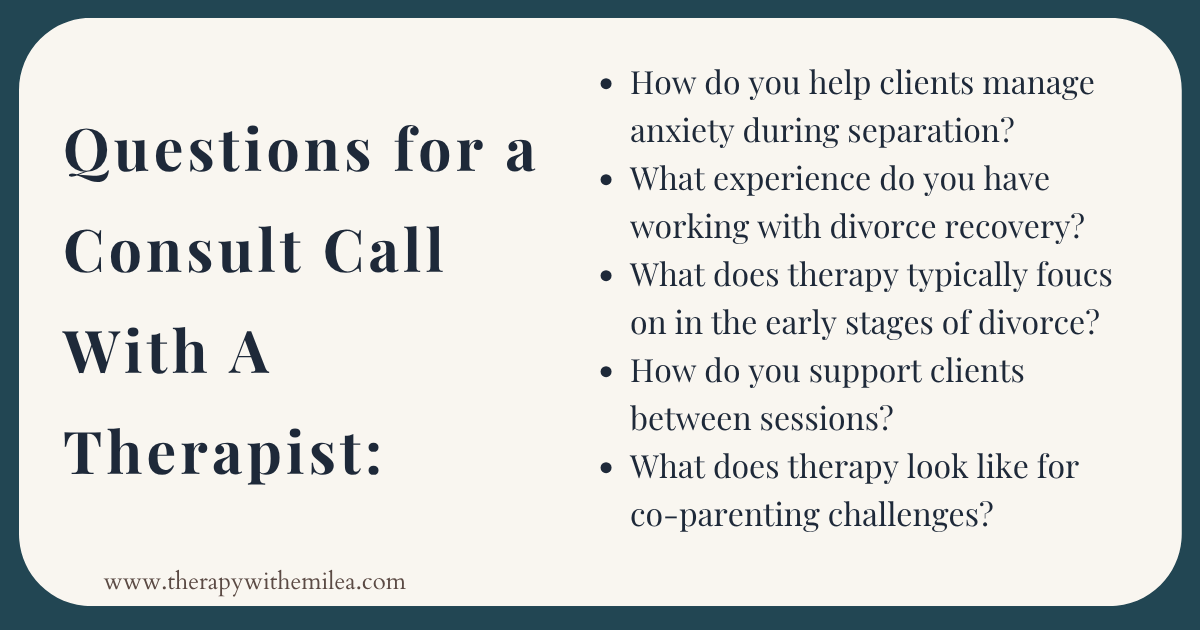
Here are some possible questions to ask during the consultation call:
How do you help clients manage anxiety during separation?
What experience do you have working with divorce recovery?
What does therapy typically focus on in the early stages of divorce?
How do you support clients between sessions?
What does therapy look like for co-parenting challenges?
Start Therapy for Divorce Recovery Today
I hope this guide on therapy for separation and divorce has been helpful. If you take anything away from this guide, remember that separation and divorce is both an emotional and nervous system transition. Therapy is a place where you can consistently get your needs met, and you deserve that during this time.
The best way to begin therapy is to start with compiling a list of therapists in your area or state, that way it’s easier for you to schedule those important consult calls.
So, what do you say? Are you ready to give it a go?
Support is available now for clients in Greenville, SC and all of South Carolina with Emilea Richardson, LMFT.